

As organizations scale, events tend to grow faster than the systems that support them. What starts as a few annual meetings or customer events can quickly turn into a full calendar of conferences, activations, internal programs, sponsor commitments, and executive expectations.
At that point, many leaders ask the same question:
Should we hire an in-house event manager, work with an agency, or bring in fractional event leadership?
There’s no universally “right” answer. The best choice depends on your stage of growth, event complexity, internal capacity, and long-term goals. This article breaks down each model objectively so you can make a clear, informed decision.
The In-House Event Manager
What this model looks like
An in-house event manager is a full-time employee responsible for planning and executing events from within the organization. They often sit within marketing, communications, HR, or partnerships.
When it works well
- You run repeatable, similar events year over year
- Event volume is consistent and predictable
- You need deep institutional knowledge and day-to-day availability
- Events are closely tied to internal teams (sales, HR, member services)
Strengths
- Strong alignment with company culture and priorities
- Immediate access and responsiveness
- Long-term ownership of vendor relationships and internal processes
- Lower per-event cost once fully ramped up
Limitations
- One person can only scale so far
- Skill gaps may appear as events become more complex
- Burnout risk is high during peak seasons
- Hiring too early can lock you into a cost before the strategy is fully defined
Best for: Organizations with steady event needs, mature internal processes, and clarity on what their events are meant to achieve.
The Event Agency
What this model looks like
An agency is an external team hired to plan and execute specific events or programs. Engagements are usually project-based or retainer-based.
When it works well
- You’re producing large, high-stakes, or one-off events
- You need rapid scale or specialized production expertise
- Internal teams lack event capacity altogether
- Speed matters more than long-term internal ownership
Strengths
- Access to a full team of specialists
- Proven production systems and vendor networks
- Ability to scale quickly for complex events
- Clear deliverables and timelines
Limitations
- Less embedded in your organization’s long-term strategy
- Knowledge often leaves once the project ends
- Can become expensive if used for ongoing, smaller events
- Agencies execute well, but may not fix underlying internal gaps
Best for: Flagship events, conferences, product launches, and moments where execution excellence is the top priority.
Fractional Event Leadership
What this model looks like
Fractional event leadership brings in a senior-level event professional on a part-time or fixed-term basis. This role focuses on strategy, structure, and oversight rather than only execution.
When it works well
- You’re growing quickly and outpacing your current systems
- Events are increasing, but you’re not ready for a full-time hire
- You need leadership, not just logistics
- Internal teams need guidance, frameworks, and decision-making support
Strengths
- Senior expertise without a full-time salary commitment
- Strategic oversight across multiple events
- Helps build internal processes, templates, and playbooks
- Bridges the gap between DIY execution and agency dependency
Limitations
- Not designed for daily hands-on logistics alone
- Requires internal buy-in to be effective
- Best impact is over months, not weeks
Best for: Organizations in transition like scaling teams, expanding event portfolios, or professionalizing their event function.
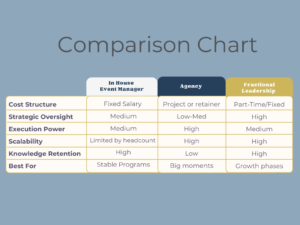
Comparing the Three Models at a Glance
Common Missteps Organizations Make
Many organizations struggle not because they chose the “wrong” model, but because they chose it at the wrong time.
Some common patterns:
- Hiring in-house too early, before event strategy is clear
- Relying on agencies for years without building internal capability
- Expecting junior roles to make senior-level decisions
- Treating events as tasks instead of strategic tools
The result is often reactive planning, stressed teams, and events that look polished but fail to deliver real business outcomes.
How to Decide What You Actually Need
Ask yourself:
- Are our events repeatable or constantly changing?
- Do we need execution help, strategic leadership, or both?
- Are we scaling volume, complexity, or visibility?
- Where do decisions currently get stuck?
Your answers will usually point clearly toward one model or a combination that evolves over time.
Final Thought
Event maturity looks different at every stage of growth. What matters most is choosing a structure that supports your organization now without limiting where you’re headed next.
Understanding the difference between in-house management, agency execution, and fractional leadership allows you to build events that are not just well-run, but well-aligned with your broader goals.